Organizations have embraced microlearning for years as a way to make training more engaging, accessible, and manageable for busy employees. Breaking lengthy courses into smaller learning experiences helped improve completion rates, increase mobile accessibility, and reduce learner fatigue.
While traditional microlearning solved some important challenges, many organizations have discovered that shorter training alone does not necessarily improve performance.
Employees may complete a five-minute learning module, pass a knowledge check, and still struggle to apply that information when faced with a real-world situation. As workplace demands become more complex, learning leaders are shifting their focus from content consumption to performance improvement.
At Brookwood eLearning, we refer to this performance-focused approach as performance-based microlearning. Rather than focusing solely on delivering information in smaller pieces, performance-based microlearning is designed to help employees apply knowledge, make better decisions, improve skills, and perform more effectively on the job. It combines targeted learning experiences, realistic practice opportunities, reinforcement activities, performance support resources, and meaningful measurement to drive lasting results.
What Is Performance-Based Microlearning?
Performance-based microlearning is an approach to learning and development that focuses on improving employee performance through short, targeted learning experiences.
Unlike traditional microlearning, which often centers on information delivery, performance-based microlearning emphasizes application, retention, and behavioral change. The goal is not simply to help employees learn something new. The goal is to help them perform better.
This approach recognizes an important reality of workplace learning. Knowledge alone does not guarantee performance.
An employee may understand a process, policy, or skill during training but still struggle to apply that knowledge effectively in a real-world situation. Performance-based microlearning bridges this gap by creating opportunities for practice, reinforcement, and support throughout the learning journey. Instead of treating learning as a one-time event, performance-based microlearning creates an ongoing process that helps employees develop confidence and competence over time.
Traditional Microlearning vs. Performance-Based Microlearning
While traditional microlearning and performance-based microlearning share the goal of making learning more accessible and efficient, they differ significantly in approach and intended outcomes. Traditional microlearning focuses primarily on delivering information in short, easy-to-consume formats. Performance-based microlearning builds on that foundation by incorporating practice, reinforcement, performance support, and continuous development opportunities that help employees apply what they learn in real-world situations. The comparison below highlights the key differences between these two approaches and illustrates why many organizations are shifting their focus from content delivery to measurable performance improvement.
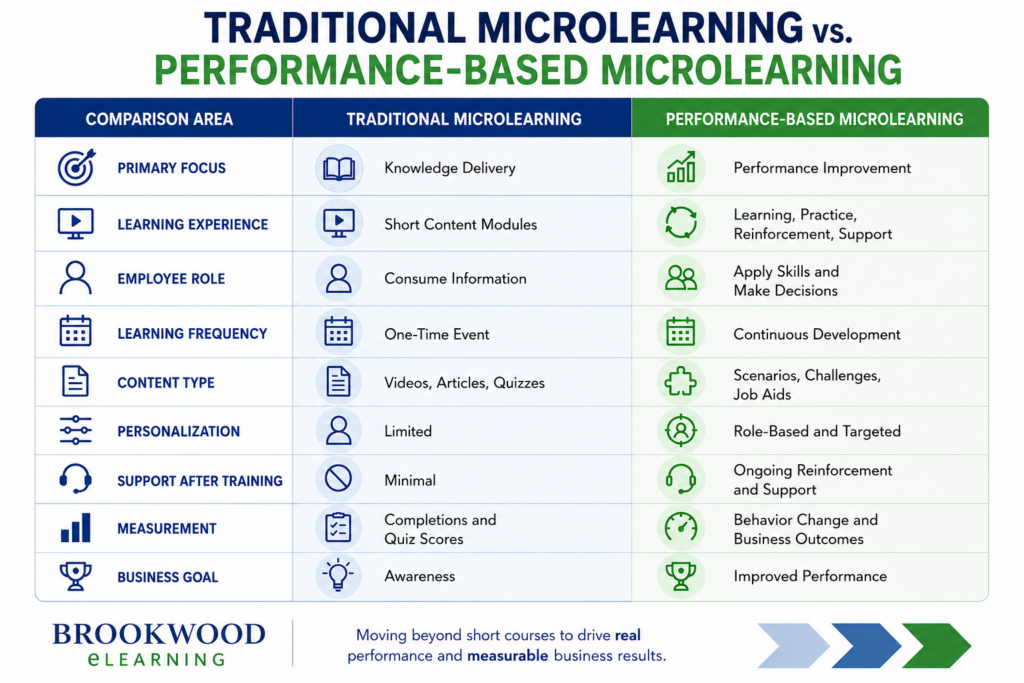
The comparison above illustrates an important shift taking place across workplace learning. Traditional microlearning was designed to make training shorter and easier to consume, helping organizations improve accessibility and engagement. While those benefits remain valuable, many learning leaders have recognized that information delivery alone does not always lead to improved job performance. Employees may complete training and understand the content yet still struggle to apply that knowledge when faced with real-world decisions and challenges.
Performance-based microlearning expands beyond content consumption by focusing on skill application, reinforcement, and measurable outcomes. Rather than viewing learning as a one-time event, organizations create continuous learning experiences that include scenario-based practice, performance support resources, personalized learning pathways, and ongoing reinforcement. The result is a more effective approach that helps employees retain knowledge, build confidence, and improve job performance. As organizations continue to prioritize productivity, employee development, and business results, performance-based microlearning is becoming a foundational strategy for modern learning and development programs.
Why Organizations Are Rethinking Workplace Learning
The modern workplace is evolving rapidly. Employees are expected to adapt to new technologies, changing regulations, evolving customer expectations, and increasingly complex responsibilities. Organizations need learning programs that prepare employees to perform in dynamic environments.
Unfortunately, traditional training approaches often struggle to meet these demands. Employees frequently complete training only to forget much of the content weeks later. Others understand concepts but fail to apply them effectively during real-world situations. This challenge is known as the learning transfer problem.
Learning transfer refers to the ability to apply knowledge and skills acquired during training to workplace performance. Many organizations invest heavily in training programs without achieving meaningful changes in behavior or business outcomes. Performance-based microlearning addresses this challenge by focusing on learning experiences that promote application rather than simple knowledge acquisition.
The Future of Workplace Learning
The future of learning and development is increasingly focused on performance. Organizations are moving beyond one-time training events and adopting continuous learning strategies that support employees throughout their development journey.
Emerging technologies such as artificial intelligence, adaptive learning systems, advanced analytics, and personalized learning platforms will continue to strengthen performance-based learning initiatives. At the same time, organizations are recognizing that successful learning programs require more than technology.
They require thoughtful instructional design, meaningful practice opportunities, reinforcement strategies, and alignment with business goals. Performance-based microlearning brings these elements together to create learning experiences that improve both employee capability and organizational performance.
Why Partner with Brookwood eLearning
Effective performance-based microlearning requires more than simply creating short courses. Organizations need a strategic partner that understands how adults learn, how employees perform, and how training can drive measurable business results.
Brookwood eLearning specializes in creating custom learning solutions that help organizations improve performance through engaging, effective, and scalable learning experiences. Our team works closely with clients to understand their goals, identify performance challenges, and develop solutions tailored to their workforce.
Our services include:
- Custom eLearning development
- Microlearning design and development
- Scenario-based learning experiences
- Learning pathway design
- Reinforcement learning strategies
- LMS implementation and administration
- Mobile learning solutions
- Accessibility and compliance support
- Learning analytics and reporting
Whether you’re looking to improve onboarding, strengthen leadership development, increase sales effectiveness, enhance compliance training, or support workforce transformation, Brookwood can help you create learning experiences that produce meaningful results.
We believe learning should do more than transfer information. It should help people perform better.